These records are found in the online catalog of The Mariners’ Museum and Park in Newport News, Virginia. Uncurated search results are presented to give researchers and interested readers an idea of whether the museum’s archives contain information about this vessel and whether it may be worthwhile to visit the museum’s catalog search page for further investigation. Uncurated results may be inaccurate or incomplete.
Mariners Museum online catalog search, July 12, 2026. Search phrase: "Schley". Catalog returned 59 records; this selection table includes 59 records fetched through catalog result pages.
Use these buttons to send uncurated search results to your own app or text document for further research. First, check the box for any row, or click "Select All" then uncheck any rows. Then click "Show Selections". You can then copy your selections from the text box and past them into your app.
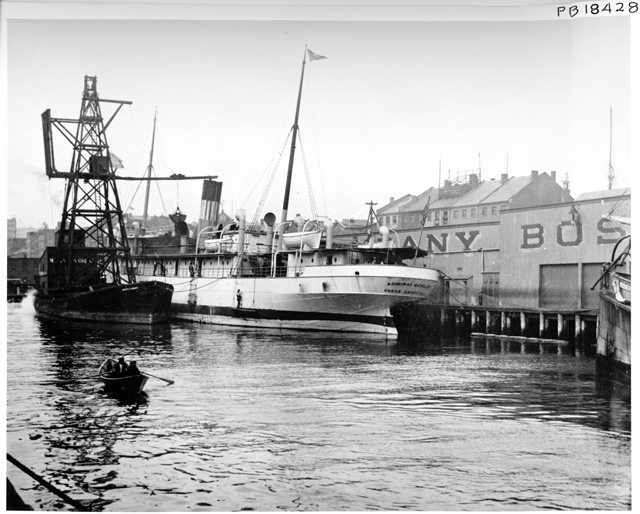
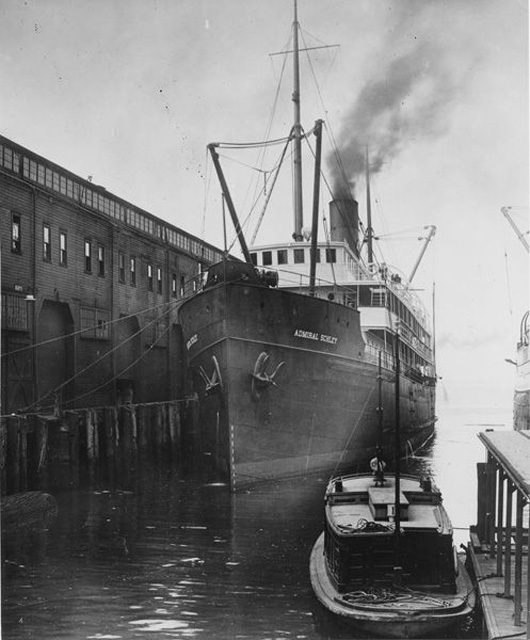
Port side view docked. View of steamship with crane alongside lighter ANNIE S. CONANT. Work men seen painting hull of ship. Two men in rowboat in foreground.
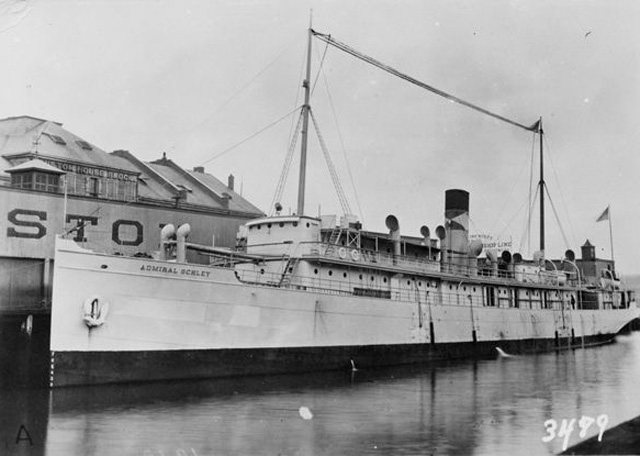
WRITTEN ON FRONT: 3479. WRITTEN ON VERSO: 3479 ADM. SCHLEY 107423 1898. STAMP ON VERSO: THE ACORES COLLECTION SOCIETY OF AMERICA, INC. BUILT 1898 IN PHILADELPHIA PENNSYLVANIA. 280 X 36.1 X 22.7 AT DIFFERENT TIMES OWNED BY ADMIRAL LINE, PACIFIC ALASKA NAV. CO, UNITED FRUIT CO.
CURATOR NOTES: Portside view of steamship at dock. Custom House Block building seen in background.
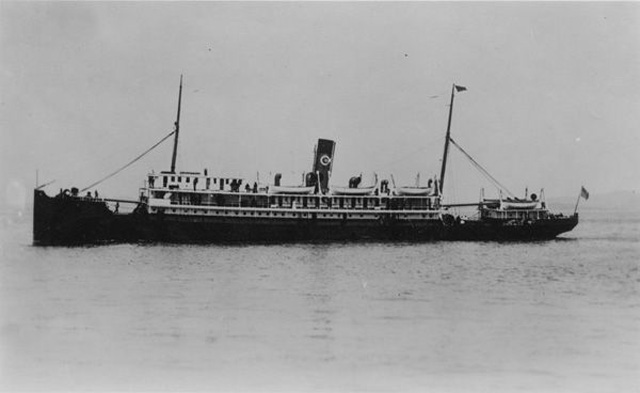
WRITTEN ON VERSO: ADMIRAL SCHLEY 1898. BUILT 1898 IN PHILADELPHIA PENNSYLVANIA. 280 X 36.1 X 22.7 AT DIFFERENT TIMES OWNED BY ADMIRAL LINE, PACIFIC ALASKA NAV. CO, UNITED FRUIT CO.
CURATOR NOTES: Portside view of steamship underway.
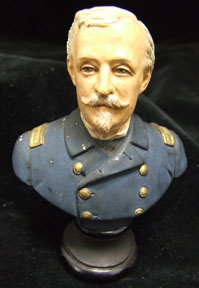
SHORT DESCRIPTION: Bisque bust in color of Commodore W.S. Schley. NOTES: Commodore Schley was born at Richfields, near Frederick, Maryland on October 9, 1839. Noted for his command of the USS BROOKLYN which played an important role in the Spanish-American War. He died on October 2, 1911.
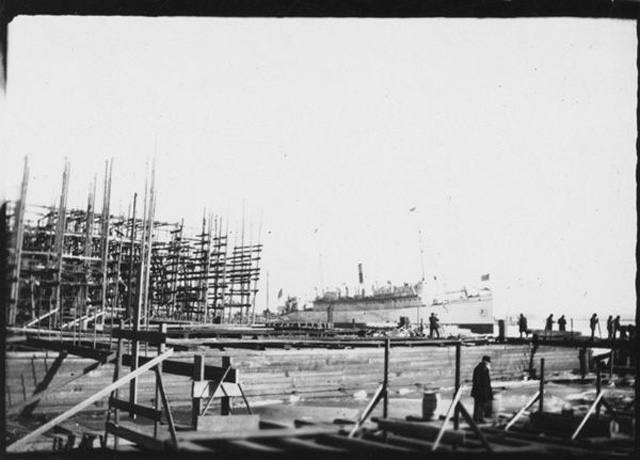
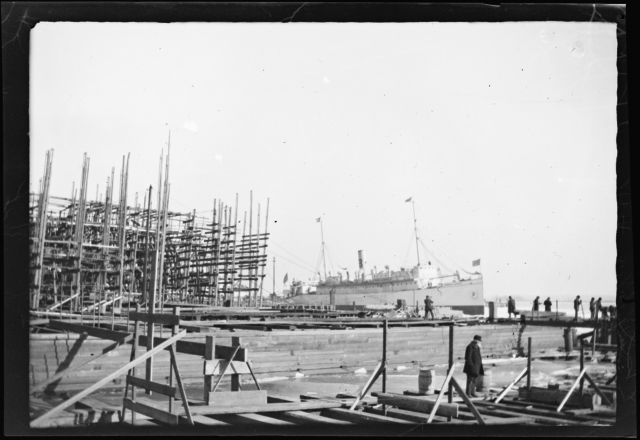
WRITTEN ON VERSO: ADMIRAL SCHLEY BUILT 1898 IN PHILADELPHIA PENNSYLVANIA. 280 X 36.1 X 22.7 AT DIFFERENT TIMES OWNED BY ADMIRAL LINE, PACIFIC ALASKA NAV. CO, UNITED FRUIT CO.
CURATOR NOTES: Starboard side view of steamship in shipyard under construction.
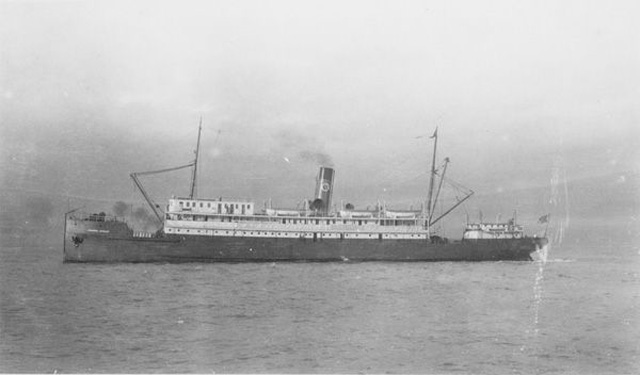
WRITTEN ON VERSO: 1335 ADMIRAL SCHLEY 107423. ALASKA PACIFIC SS CO., JAN. 5, 1919-AT SAN FRANCISCO. STAMP ON VERSO: PHOTO BY WM. T. MILLER, P.O. BOX 25, TRAIL, OREGON. BUILT 1898 IN PHILADELPHIA PENNSYLVANIA. 280 X 36.1 X 22.7 AT DIFFERENT TIMES OWNED BY ADMIRAL LINE, PACIFIC ALASKA NAV. CO, UNITED FRUIT CO.
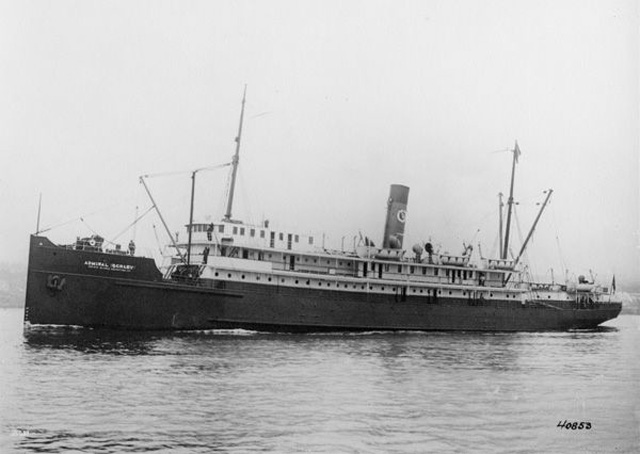
CURATOR NOTES: Portside view of steamship underway.
WRITTEN ON FRONT: 40853. WRITTEN ON VERSO: 35029 S.S ADMIRAL SCHLEY. BUILT 1898 IN PHILADELPHIA PENNSYLVANIA. 280 X 36.1 X 22.7 AT DIFFERENT TIMES OWNED BY ADMIRAL LINE, PACIFIC ALASKA NAV. CO, UNITED FRUIT CO.
CURATOR NOTES: Close portside of view of steamship underway.
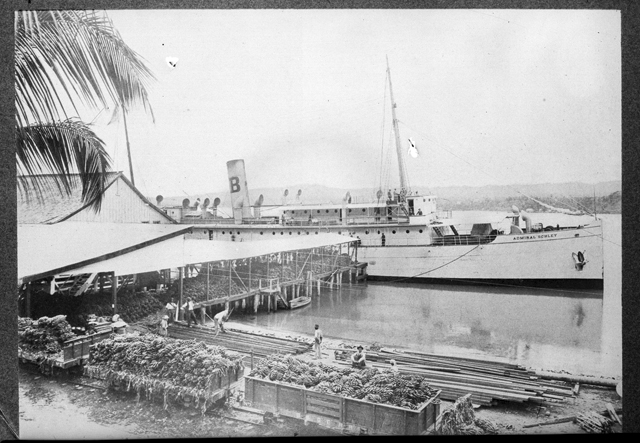
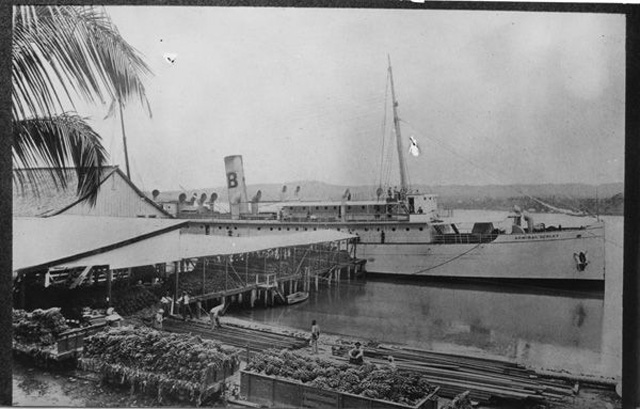
WRITTEN ON VERSO: ADMIRAL SCHLEY BUILT 1898 IN PHILADELPHIA PENNSYLVANIA. 280 X 36.1 X 22.7 AT DIFFERENT TIMES OWNED BY ADMIRAL LINE, PACIFIC ALASKA NAV. CO, UNITED FRUIT CO.
CURATOR NOTES: Starboard side view of steamship docked, loading bananas. Workers seen in foreground near carts of bananas.
WRITTEN ON VERSO: 1980 ADMIRAL SCHLEY 107423. JULY 25, 1931 AT SAN FRANCISCO. STAMP ON VERSO: PHOTO BY WM T. MILLER, P.O. BOX 25, TRAIL, OREGON. BUILT 1898 IN PHILADELPHIA PENNSYLVANIA. 280 X 36.1 X 22.7 AT DIFFERENT TIMES OWNED BY ADMIRAL LINE, PACIFIC ALASKA NAV. CO, UNITED FRUIT CO.
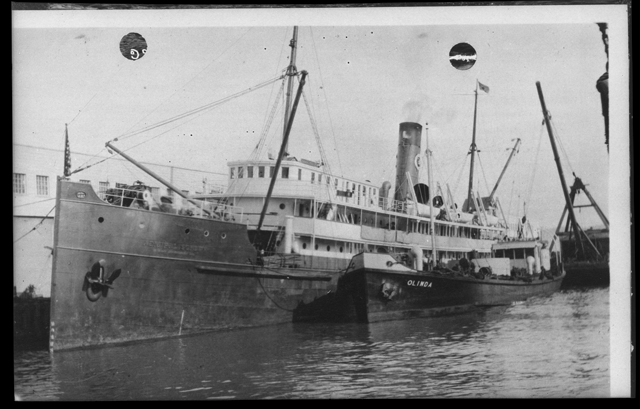
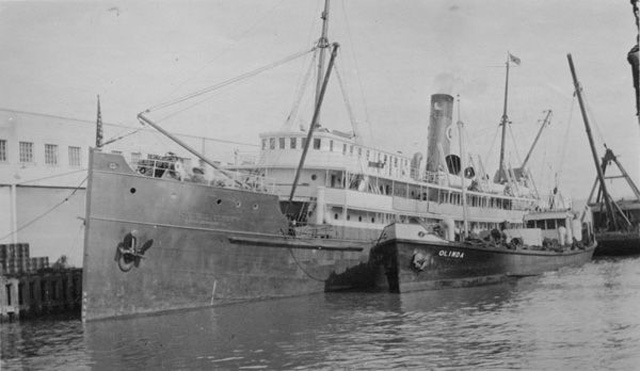
WRITTEN ON VERSO: S.S. ADMIRAL SCHLEY, OWNED BY PACIFIC S.S. CO., SAN FRANCISCO, CAL. INSPECTED BY J.M.V.B. JAN. 28, 1918. LENGTH, 280; BEAM, 36.1; DEPTH, 22.2; GROSS TONS, 2104; NET, 1335. CAPACITY, 2206 TONS. SPEED, 12.5 KTS. RADIUS, 3270 KTS. COULD BE INCREASED TO 4100 KTS. BY USING #4 AND #5 BALLAST TANKS FOR FUEL OIL. BUILT 1898 IN PHILADELPHIA PENNSYLVANIA. 280 X 36.1 X 22.7 AT DIFFERENT TIMES OWNED BY ADMIRAL LINE, PACIFIC ALASKA NAV. CO, UNITED FRUIT CO.
CURATOR NOTES: Portside view of steamship docked beside smaller boat OLINDA. Two holes punched on top of photo. Ship information typed on back.
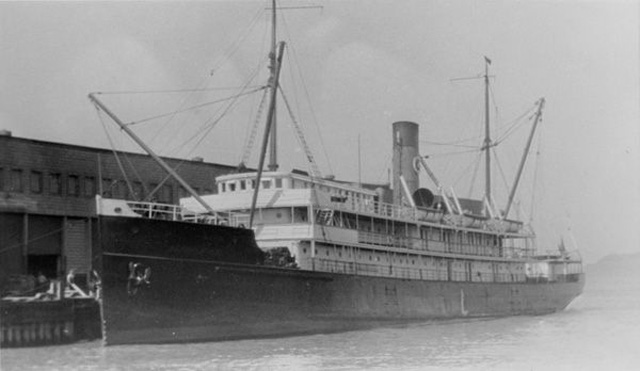
WRITTEN ON VERSO: 280 X 36.1 X 22.7 1989. BUILT 1898 IN PHILADELPHIA PENNSYLVANIA. 280 X 36.1 X 22.7 AT DIFFERENT TIMES OWNED BY ADMIRAL LINE, PACIFIC ALASKA NAV. CO, UNITED FRUIT CO.
CURATOR NOTES: Close portside bow view of steamship docked. Unidentified tug seen in foreground.
Courts-martial and courts of inquiry–United States.; Santiago, Battle of, Santiago de Cuba, Cuba, 1898.
Pictorial history of the Schley Court of Inquiry - reproduced from the Washington Post ; illustrations by Clifford K. Berryman and text by Henry Litchfield West
373 FIFTH AVENUE - NEW YORK - NEW YORK - UNITED STATES - Publisher
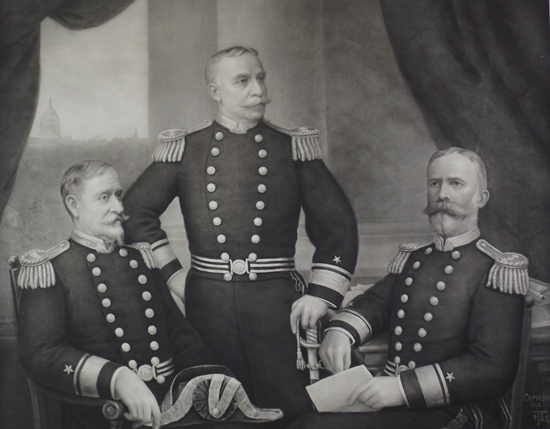
SHORT DESCIRPTION: Black and white print showing Admirals Schley and Sampson seated in chairs with Admiral Dewey standing between them. Dewey's left hand is resting on the hilt of a sword. NOTES: Adm. George Dewey, 1837-1917 Admiral Winfield Scott Schley, 1839-1909 Adm William Sampton, 1840-1907
SHORT DESCRIPTION: Glass tumbler with white transfer print portrait of Admiral Dewey and Commodore Schley, wingspread eagle clutching an American shield, and crossed American and Cuban flags are on side.
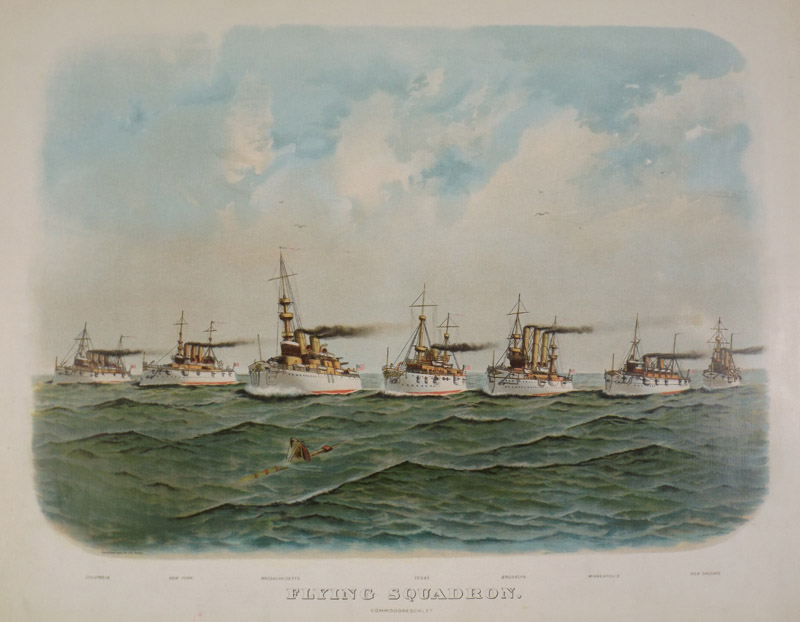
NOTES: Commodore Schley was in command of the "Flying Squadron" organized at Hampton Roads on March 24, l898. This squadron operated as an independent unit until merged with Sampson's Fleet off Santiago, June 21, l898. Schley's flag was flown from U.S. Cruiser BROOKLYN.
SHORT DESCRIPTION: Glass tumbler with portrait of Commodore W. S. Schley, USN, around which appears draped American and Cuban flags, wingspread eagle, bow of a naval vessel, two cannon barrels, and a group of soldiers marching. The flags are in colors and the entire transfer is enclosed with a gilt edge border. NOTES: Commodore Winfield Scott Schley was born at Richfields, near Fredrick, Maryland on October 9, 1860. He died on October 2, 1911.
In 1900 the author published a pamphlet of 64 pages with title "A review of the naval campaign of 1898, in the pursuit and destruction of the Spanish fleet commanded by Admiral Cervera."
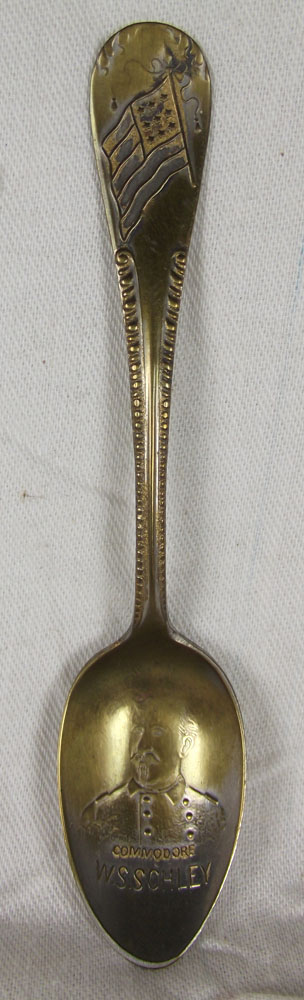
SHORT DESCRIPTION: Obverse: In the bowl appears a portrait of, and the inscription Commodore W. S. Schley. At the top of the handle appears the likeness of the American Flag but with six stars. Reverse: STANDARD. LABEL: Commodore W.S. Schley Of the Spanish American War Souvenir spoon FS 215
Admirals of American empire : - the combined story of George Dewey, Alfred Thayer Mahan, Winfield Scott Schley, and William Thomas Sampson - by Richard S. West, Jr
Admirals of American empire : - the combined story of George Dewey, Alfred Thayer Mahan, Winfield Scott Schley and William Thomas Sampson - Richard Sedgewick West
Spanish-American War, 1898–Naval operations.; Santiago, Battle of, Santiago de Cuba, Cuba, 1898.
Paged continuously. Issued also without document series note ("Bureau ed.") Included in v. 2: Findings of the court, and opinion of Admiral Dewey; Rear-Admiral Schley's "Petition for relief from the findings and report of a court of inquiry, and accompanying papers"; The President's memorandum upon the appeal of Admiral Schley; Appendix, containing logs of the battle-ships, signals, etc.; Index prepared in the Office of the Superintendent of Documents.
HENRY W. LONGFELLOW (STEAMSHIP: 1942) - USS WEST POINT (TROOPSHIP, AP-23: 1941-1946)
Three officers representing the Office of Strategic Services, all members of the 2,677th Regt., are photographed on Pier 6 after debarkation from USS WEST POINT. They are, left to right, Major J. Andy Rogers, O-1101638, El Paso, Texas, who had sailed from HRPE aboard the SS HENRY WADSWORTH LONGFELLOW on 10 Oct. 43; Capt. Robert R. Rovzar, O-409861, New York, N.Y., who had 23 months overseas; and Capt. Reeve Schley, Jr., O-1031128, White House, New Jersey. Photo taken at Pier 6, HRPE, Newport News, Va., for Historical records.
Shows a group of men standing together on the pier after debarkation. Reeve Schley, Jr., was part of a prominent New Jersey family that included businessmen and politicians.
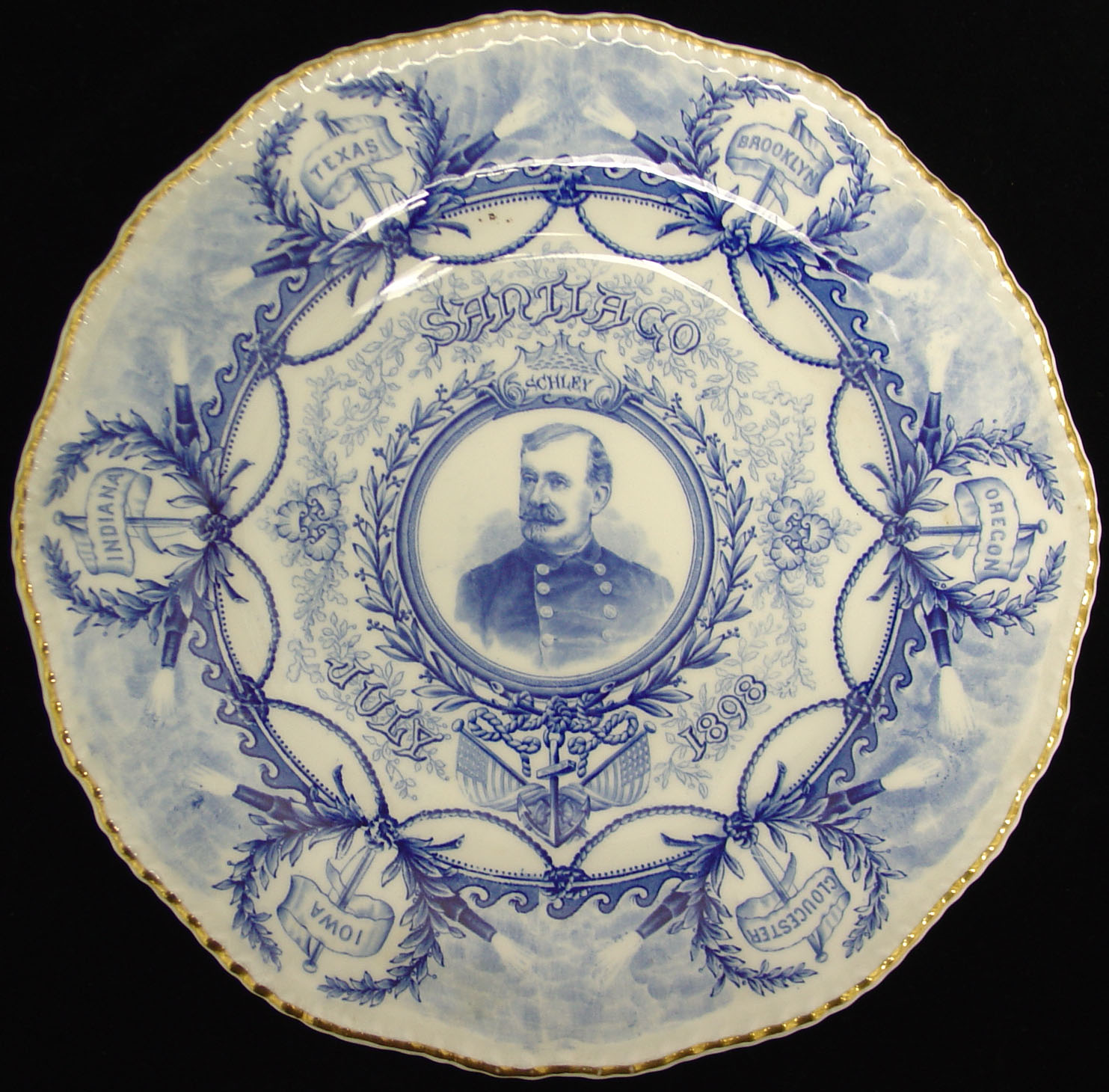
SHORT DESCRIPTION: Blue and white commemorative porcelain plate with a portrait of Rear Admiral Winfield Schley in center with the inscription 'Santiago, July 1898'. Around the borders are banners bearing the names of the ships of Commodore Schley's naval squadron. The squadron consisted of the Brooklyn, Texas, Iowa, Oregon, Indiana, and Gloucester.
SHORT DESCRIPTION: Ceramic stein; green background with raised bust portraits of General Miles, Admiral Schley, Admiral Dewey, Admiral Sampson, and General Lee. Object has a pewter lid. LABEL COPY: STEIN, circa 1898 The Mariners' Museum FN 749 (Collections Gallery, Fall 1998
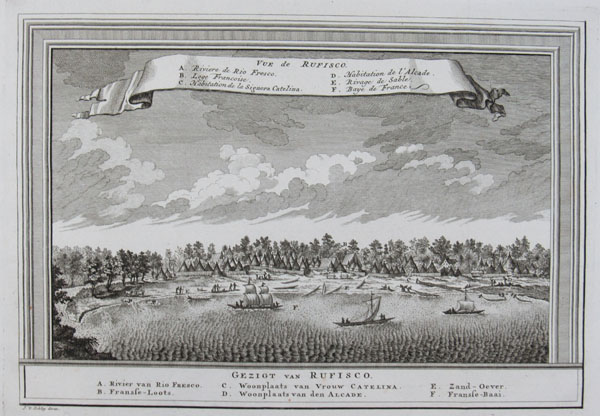
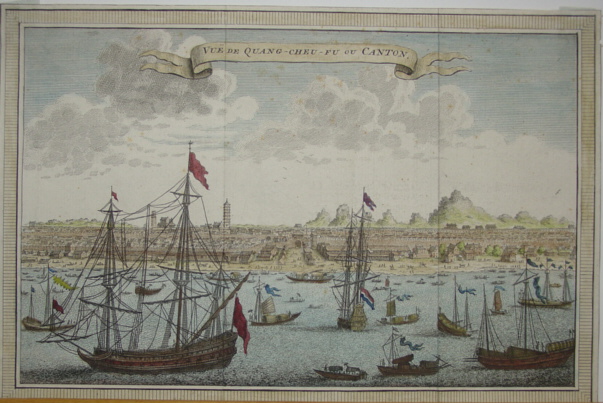
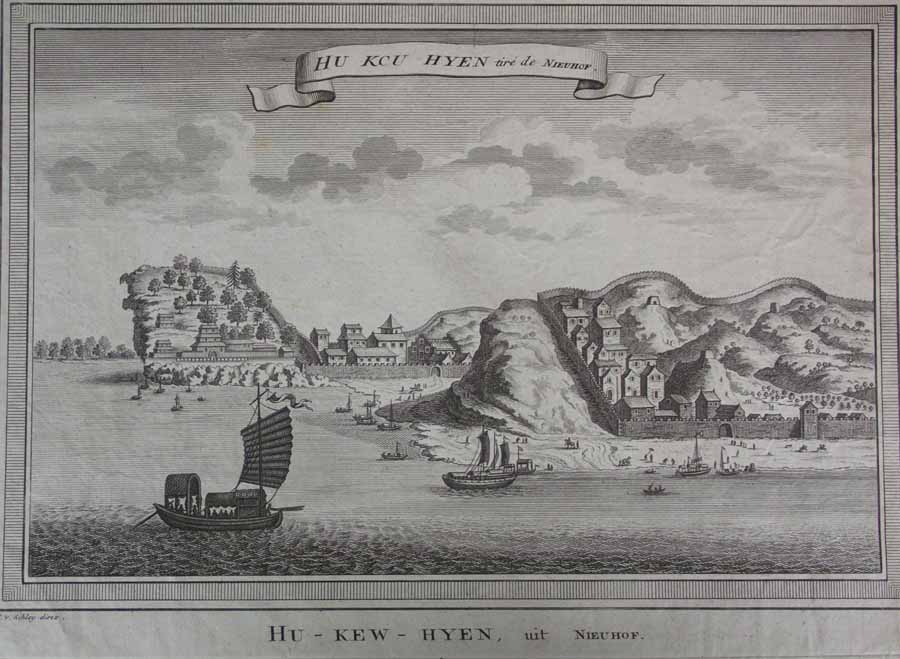
ASSISTANT CURATOR'S NOTES: [Martha Jones Wyatt, September 5, 2000] LE 1267, Hu-Kew-Hyen Tire de Nieuhof (China), and LE 1300, Vue De Rufisco (Africa), both appear to be plates from the following publication: Histoire generale des voyages; ou, Nouvelle collection de toutes les relations de voyages par mer et par terre, qui ont ete publiees jusqua' a present dans les nations…by Abbe Prevost or (A.F. Prevost), ca. 1750. Volumes 1-10 or 1-7 (there seems to be some uncertainty in how many volumes were translated from Green) are from John Green's, A new general collection of voyages and travels, London, T. Astley, 1745-7. Prevost later translated these volumes into French and added 8 volumes of his own collections and insights. Between 1746 and 1759, Prevost's fifteen volume Histoire generale des voyages were published and quickly became successful. The volumes were also posthumously expanded. The first edition soon became very desirable, and many settled for the less expensive quarto edition published in eighty volumes over the period of 1746 to 1789. Major explorers and voyagers, such as Montcalm and Bougainville carried Prevost's edition with them as they crossed the seas and his influence can be seen in the works of Buffon in his Encyclopedia and the writings of Rousseau. LE 1267, is from Volume VII. after page 22 and LE 1300 comes from Volume III, after p. 272. Jakob van der Schley is the engraver of both plates. Volumes 1-25 can be found in The Mariners' Museum Research Library and Archives, (G 160.P9 Rare). The volumes were purchased for the library in 1934.
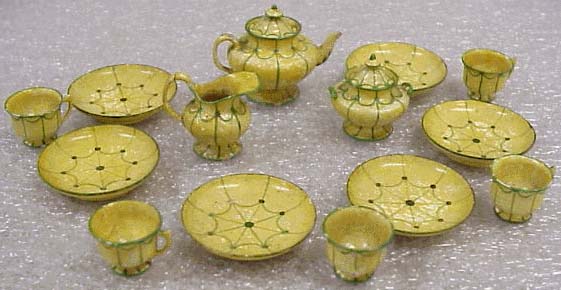
NOTES: Pitcher with lid from set of miniature dishes made out of wood, painted white and trimmed in green. Set includes: 6 cups, 6 saucers, 1 tea pot with lid, 1 cream pitcher and 1 sugar bowl with lid, all in wooden case with blue velvet lining on the bottom. Handle of one cup missing. Saucer is 1-5/16" diameter. Teapot is 1-3/16" in diameter. Donor has stated: "This set of dishes were brought to my mother as a souvenir, from Vienna by Winfield Scott Schley, Rear Admiral Schley, after his first cruise on graduating from the Naval Academy in 1860 or 1861. My mother Henrietta Stewart was daughter of the acting President of St. Johns College" INVENTORY: teapot and lid, sugar bowl, creamer, six (6) cups, six (6) saucers - there are fifteen (15) component parts.
Title vignettes, initials, tall-pieces. Vols. 1-2 only of the 3d edition; v. 4 in 2 vols., each with separate t.-p. and paging. Vols 3-4 have title: The history of England, by Mr. Rapin de Thoyras. Continued from the revolution to the accession of King George II by N. Tindal. 1744-47. The portraits were engraved by G. Vertue and J. Houbraken; the plates by G. Vertue, C. du Bosc, J. V. Schley, and P. Yver. "The metalic history of the three last reigns": v. 3, iv, 40 p. at end; v. 4, pt. 2, 22 p. A summary of the history of Engalnd, from the invasion of Julius Caesar to the death of George I: 274 p. at end of v. 4.
The rescue of Greely - by W.S. Schley, commanding the relief expedition of 1884, and J.R. Soley ; illustrated from the photographs and maps of the relief expedition
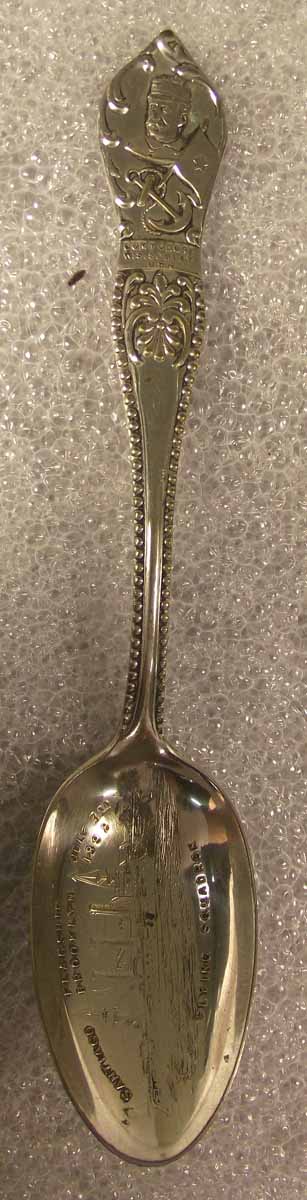
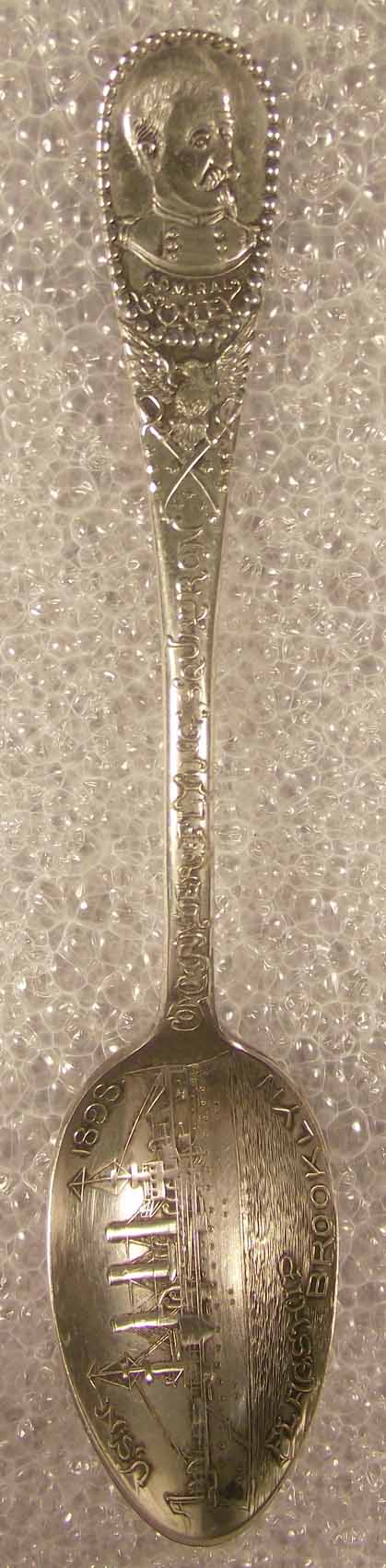
SHORT DESCRIPTION: Obverse: In the bowl appears the starboard side view of the cruiser BROOKLYN at anchor and the inscription: Flying Squadron Flagship BROOKLYN, Santiago, July 3rd, 1898. At the top of the handle is a portrait of Commodore W.S. Schley, U.S.N., a fouled anchor, and a single star flag. LABEL: U.S.S. BROOKLYN "U.S.N. 1898 Flagship," built at Philadelphia, 1893-96.Souvenir spoons FS 180, FS 211 VESSEL INFORMATION- VESSEL NAME: USS BROOKLYN VESSELT BUILT: 1895 SHIP BUILDER: WM CRAMP & SONS BUILDER LOCATION: PHILADELPHIA, PENNSYLVANIA VESSEL DIMENSIONS: 402'7" x 64'8" x 28'
SHORT DESCRIPTION: Nickle silver medal featuring a portrait of Admiral William T. Sampson under which appears his name. Around the border appears:- Fiftieth Anniversary of the Navy & Fourth of July Present. In the field:- 1898-1948. The reverse contains the inscription: DESTRUCTION OF SPANISH FLEET OFF SANTIAGO CUBA JULY 3, 1898. THE FLEET OFFERS THE NATION AS A FOURTH OF JULY PRESENT THE WHOLE OF CERVERAS FLEET - SAMPSON, THERE IS GLORY ENOUGH FOR ALL - SCHLEY ADDITIONAL INFORMATION: See Schley, Sampson & Cervera" by James Parker. See also "With Sampson through the War" by W.A.M. Goode.
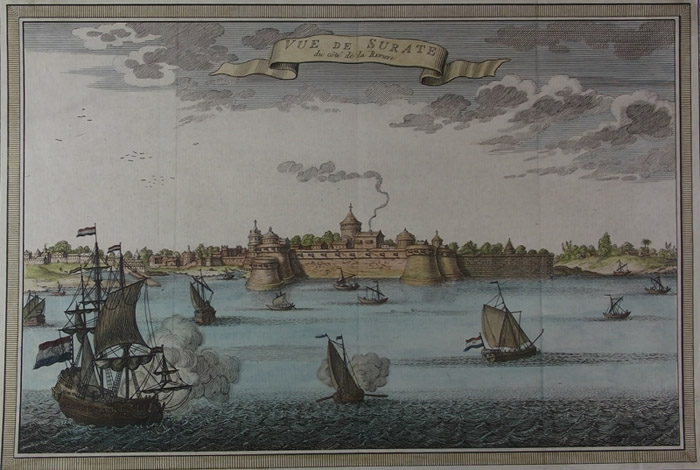
NOTES: This image may be from "The Universal traveller: or, a compleat description of the several nations of the world... Brough down to the present time. And Illustrated with a great variety of maps and cuts. By Mr. Salmon", by Thomas Salmon, London, Printed for R. Baldwin, 1752-1753. See TMM library Rare G114.S17 Oversize. Plate 8, No. 5, Page 9 is in Chapter II. G. Childe is the engraver. It is possible that it could also be by Jacob van der Schley for Antoine-François Prevost, ca 1750 but a comparable image could not be found.
NEW YORK, NEW YORK; RELATED PLACE: PENNSYLVANIA, PHILADELPHIA
SHORT DESCRIPTION: Obverse: In the bowl appears a starboard side view of the U.S.S. BROOKLYN and the inscription: USN 1898 FLAGSHIP USS BROOKLYN On the handle appears: COMMANDER OF FLYING SQUADRON, and a portrait of Admiral Schley. Below the portrait appears a wingspread eagle clutching crossed swords. Reverse: Crown Silver Plate Co. LABEL: U.S.S. BROOKLYN "U.S.N. 1898 Flagship," built at Philadelphia, 1893-96.Souvenir spoons FS 180, FS 211 VESSEL INFORMATION- VESSEL NAME: USS BROOKLYN VESSELT BUILT: 1893-96 SHIP BUILDER: WM CRAMP & SONS BUILDER LOCATION: PHILADELPHIA, PENNSYLVANIA VESSEL DIMENSIONS: 402'7" x 64'8" x 28'
PENNSYLVANIA, PHILADELPHIA; RELATED PLACE: CUBA, SANTIAGO
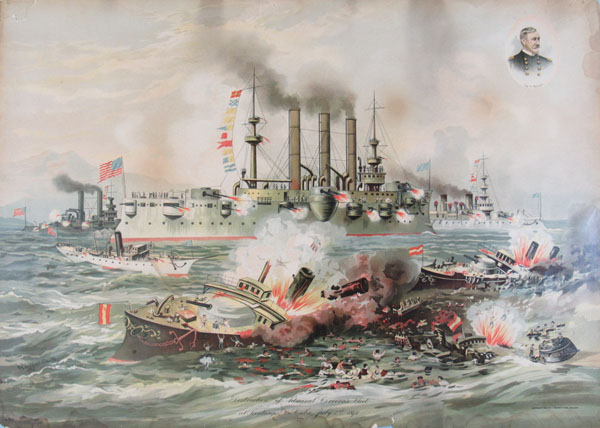
SHORT DESCRIPTION: Color lithograph depicting the destruction of Admiral Cervera's Fleet at Santiago de Cuba on July 3rd, 1898. One of the ships depicted is either the USS OREGON or USS INDIANA. There is also an inset portrait of W.S Schley in the upper right corner. LABEL COPY: Battle of Santiago/3 July 1898/haste to do now what must be done anon/Or some mad hope of selling triumph dear/Drive the ships forth: soon was INFANTA MARIA TERESA gone/FUROR, PLUTON, VIZCAYA, ALMIRANTE OQUENDO, and CRISTOBAL COLON./From "Spain in America" in POEMS/by George Santayana/On 3 July 1898 the Spanish fleet under Admiral Cervera attempted to break out of the American blockade of Santiago Bay. Within a few hours all of Cervera's squadron was sunk or stranded by the United States Navy under Admiral Sampson and Commodore Schley. Her naval power crushed, Spain was forced to sue for peace at the end of July. America's "New Navy" had presided over the conquest of Cuba and the expulsion of Spain from the Western Hemisphere. VESSEL INFORMATION - VESSEL NAME: VIZCAYA VESSEL TYPE: Infanta Maria Teresa-class armored cruiser BUILDER LOCATION: SPAIN, BILBAO BUILD DATE: 1890-1891 SHIPOWNER: SPANISH NAVY VESSEL DIMENSIONS: 7000 tons, 340 x 65 x 21.6 FATE: Sunk at the Battle of Santiago, July 3, 1898. VESSEL HISTORY: Vizcaya was an armored cruiser of the Spanish Navy that fought at the Battle of Santiago de Cuba during the Spanish-American War. She was laid down in 1889, launched on 8 July 1891, and completed in 1893.
ASSISTANT CURATOR'S NOTES: [Martha Jones Wyatt, September 5, 2000] LE 1267, Hu-Kew-Hyen Tire de Nieuhof (China), and LE 1300, Vue De Rufisco (Africa), both appear to be plates from the following publication: Histoire generale des voyages; ou, Nouvelle collection de toutes les relations de voyages par mer et par terre, qui ont ete publiees jusqua' a present dans les nations…by Abbe Prevost or (A.F. Prevost), ca. 1750. Volumes 1-10 or 1-7 (there seems to be some uncertainty in how many volumes were translated from Green) are from John Green's, A new general collection of voyages and travels, London, T. Astley, 1745-7. Prevost later translated these volumes into French and added 8 volumes of his own collections and insights. Between 1746 and 1759, Prevost's fifteen volume Histoire generale des voyages were published and quickly became successful. The volumes were also posthumously expanded. The first edition soon became very desirable, and many settled for the less expensive quarto edition published in eighty volumes over the period of 1746 to 1789. Major explorers and voyagers, such as Montcalm and Bougainville carried Prevost's edition with them as they crossed the seas and his influence can be seen in the works of Buffon in his Encyclopedia and the writings of Rousseau. LE 1267, is from Volume VII. after page 22 and LE 1300 comes from Volume III, after p. 272. Jakob van der Schley is the engraver of both plates. Volumes 1-25 can be found in The Mariners' Museum Research Library and Archives, (G 160.P9 Rare). The volumes were purchased for the library in 1934.
Transports–United States.; Steamboats–United States.; World War, 1914-1918–Naval operations, American.
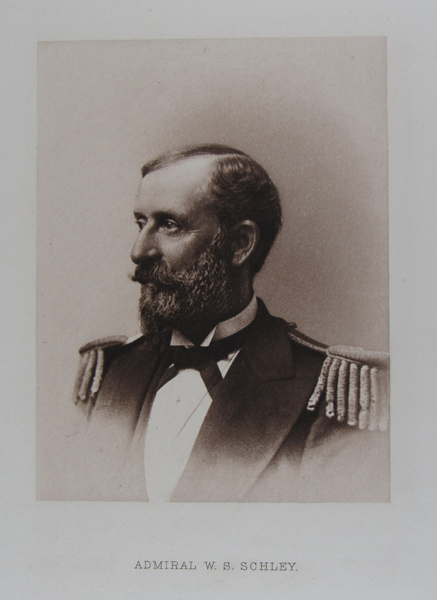
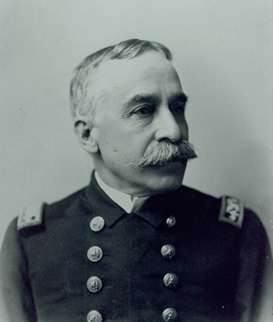
This collection features 4"x6" copy prints of the transport USS HENDERSON (AP-1) and her crew. Of note are photos from a fire onboard ship in July 1918. This vessel appears both in and out of dazzle paint. The prints are captioned. There are also photos of SS AQUITANIA in dazzle paint, the ship's mascot, and Admiral Winfield Schley.
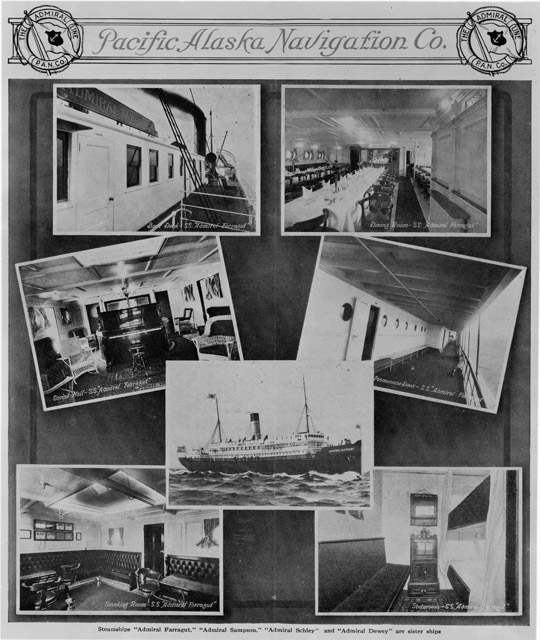
WRITTEN ON FRONT: THE ADMIRAL LINE, PACIFIC ALASKA NAVIGATION CO. STEAMSHIPS "ADMIRAL FARRAGUT, " "ADMIRAL SAMPSON," "ADMIRAL SCHLEY" AND "ADMIRAL DEWEY" ARE SISTER SHIPS. WRITTEN ON VERSO: ADMIRAL FARRAGUT. BUILT 1898, AT PHILADELPHIA, BY W. CRAMP & SONS CO. AT DIFFERENT TIMES OWNED BY ADMIRAL LINES, PACIFIC ALASKA NAV. CO., AND UNITED FRUIT CO. 2141 T. 280 X 36.1 X 22. 7. SOLD TO JAPANESE 1934, TO BE BROKEN UP.
CURATORS NOTES: Copy print of Pacific Alaska Navigation Steamship Co. promotional material showing 7 images. Dining room, social hall, smoking room, state room, boat and promenade decks.
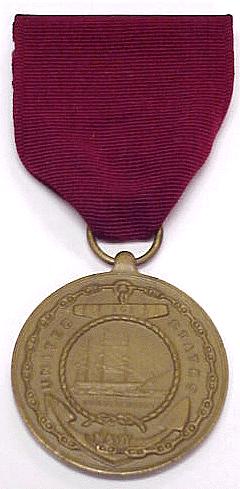
SHORT DESCRIPTION: Display copy of the Navy Good Conduct medal (third copy). In the center of a bronze medallion one and a quarter inches in diameter is a starboard broadside view of a ship under full sail . Beneath the ship is the word CONSTITUTION. , The ship and inscription are contained within a circle of rope tied at the base. The scene is superimposed over an anchor, with its stock appearing above and its flukes below. The anchor's chain forms a circle between the rope and the edge of the medal. Within the circles formed by the rope and chain are the words UNITED (on the left) STATES (on the right) and NAVY (across the lower part of the anchor). The ship is the Constitution, one of six frigates authorized by Act of Congress on March 27, 1794. Launched on October 21, 1797, the Constitution was a "ship of beauty, power, and speed ... fashioned as a national expression of growing naval interest, and a symbol auguring the dedication, courage, and achievement of the American fighting men and ships." The Constitution thus represents the American naval tradition. The cable, anchor, and chain are nautical symbols further referring to naval service. The center of the reverse is blank for inscribing the recipient's name. The word FIDELITY appears on the inside contour on the left; the word OBEDIENCE on the right, and ZEAL at the base. These words are taken from the original Good Conduct Medal and represent the virtues recognized by the medal. The third ribbon, which came into use in about 1885, was a relatively bright shade of solid red. NOTES: The Good Conduct Medal was initially awarded to enlisted men of the Navy who completed a second (or subsequent) enlistment of three years under Continuous Service; obtained a general average of 4.5 on their Conduct Records, and who were recommended by their commanding officer. In time it came to be awarded for the honorable completion of a fixed term of service. The transitional design of the Navy Good Conduct Medal was done by Commodore Winfield Scott Schley and was based on the Navy logo then in use on certain documents, which itself bore a striking resemblance to the reverse design of Great Britain's Royal Navy Long Service and Good Conduct Medal. NOTES: This medal was originally part of a panel of 34 U.S. Navy and U.S. Marine Corps medals that were donated by the U.S. Navy Department.
L6674 - French volunteer nurses of shipment IJ-432 GB assembled at the IP at Avenue C and 7th Capt Street, Camp Patrick Henry, L to R, front row are: Major Lola Gabriel-Voisin; Lts. Gabrielle Landormy, Elaine Aubard Schley, Simmone Renee Boisbourdin, Giselle Voisin, and Jacqueline Devred. L to r, backrow, are: Capt. Colombe de Pons, and Lts. Eveline Osso, Jacqueline Colombain, Denise Y. Ulimann, and Martha Riant. 2-27-44 Official Photograph, U. S. Army Signal Corps, HRPE, Newport News, Va. "SECRET Authority WD Cir 346 October 15, 1942 Initials WCS Date 17 FEB 1944" stamped in red ink.
Two rows of French nurses in winter uniforms, carrying bags and packs, stand outdoors at Camp Patrick Henry.
Members of the 1st Armored Division holding grand reunion on Pier 6, HRPE, Newport News, Va., at the debarkation of the USS WEST POINT. The 1st Armored Division sailed overseas on 10 May 1942 from NYPE aboard the HMS QUEEN MARY. Left to right: Sgt. Frank Fattizzi, 32081874, 3151 Schley Ave., New York, N.Y., of the 16th Engineers; S/Sgt. John Arszol, 32059844, 1608 89th Street North Bergen, N.J., 68th F.A.; Sgt. Otto H Haass, 32175622, 111 80th Street, Brooklyn. N.Y., 47th Med. Co.; Sgt. K.L. Crable, 2504914, Terre Haute, Ind., formerly a member of the 13th Armored Regt., 1sst Armored Div., who was returned to the U.S. in Oct 44 and now is assigned to HRPE as a dispatcher; and Sgt. George L. Lockwood, 32120798, 4129 South Third Street, Woodside, Long Island, New York, 47th Med. Co. The 1st Armored Division, one of the first American outfits to perform active duty overseas, has distinguished itself in Tunisia, Algeria, Anzio, and Rome. Photo taken for Historical purposes.
Reunions–Virginia–Newport News.
Shows five men waiting on an HRPE pier, they are smiling and chatting together.
BROOKLYN - NEW YORK - UNITED STATES - Related Place
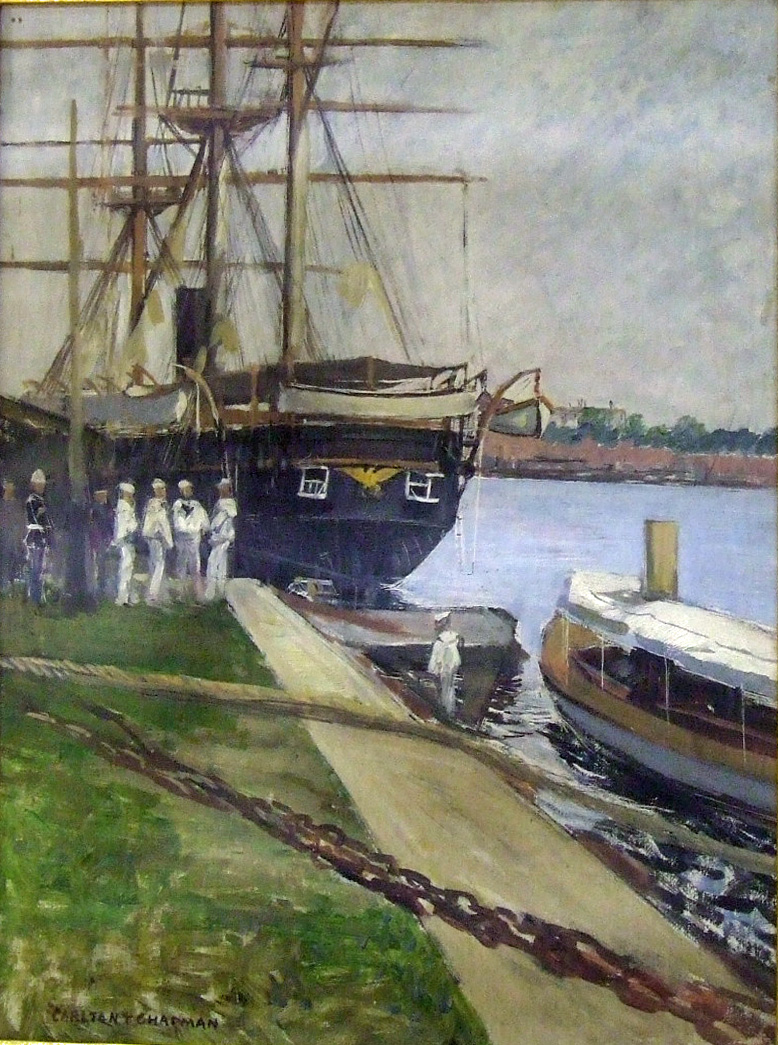
SHORT DESCRIPTION: Painting by Carlton Chapman showing the USS Essex at a pier at the Brooklyn Navy Yard in 1896. There are several sailors standing near the ship. NOTES: Between January 1894–April 1898 the USS Essex served as a training ship for naval apprentices. VESSEL INFORMATION: VESSEL NAME: USS ESSEX (1876) Commissioned: 3 October 1876 Decommissioned: May 1889 Struck: 27 October 1930 Fate: Sold General characteristics Vessel Type: Wooden screw steamer Displacement: 1,375 long tons (1,397 t) Length: 185 ft (56 m) Beam: 35 ft (11 m) Draft: 14 ft 3 in (4.34 m) Propulsion: Steam engine Speed: 10 knots (19 km/h; 12 mph) Armament: 1 × 11 in (280 mm) gun, 4 × 9 in (230 mm) guns, 1 × 60-pounder gun Designer: Donald McKay USS ESSEX, the third ship of that name, was built by the United States and Donald Mackay at East Boston, Massachusetts; commissioned at the Boston Navy Yard on 3 October 1876, Commander W. S. Schley commanding; and reported to the North Atlantic Squadron. During the following year USS ESSEX cruised to Liberia and along the west coast of Africa and in 1878-79 joined the South Atlantic Squadron. She sailed on the Pacific Station from November 1881 to December 1882 and thence on the Asiatic Station for two years during which she took on board Captain S. H. Morrison and crew members of the shipwrecked Ranier. Following repairs' she returned to the Asiatic Station under command of Commander T.F. Jewell in June 1886 and in October anchored at Ponape, Caroline Islands, to afford protection to American missionaries during a native uprising. She returned to New York via the Suez Canal and was placed out of commission in May 1889. Regarded as one of the finest ships of the fleet, USS ESSEX was designated next as a training ship. A three-month cruise with cadets at the Naval Academy at Annapolis in 1893 was followed by two lengthy tours to train naval apprentices (January 1894-April 1898, and September 1898 to December 1903.) USS ESSEX was lent to the Ohio Naval Militia (1904-16) and served in the Ninth Naval District from 1917 to 1926. The Naval Reserve of the State of Minnesota used her as training and receiving ship from 1921 until 27 October 1930 when she was stricken from the Navy List. She was sold for scrap on 23 December 1930 and subsequently burned near Duluth. NOTES: Carlton T. Chapman was born September 18, 1860 to Henry and Margaret Chapman. They lived in Ohio, but Chapman spent summers at his uncle’s shipyard in Maine, where his father was born. During his teenage years Chapman worked as a cabinet maker with his father, according to the 1880 census. Chapman’s artwork focused on the maritime world, and after art school the U.S. Naval Academy commissioned him to paint images of the War of 1812, which appear in James Barnes’ “Naval Actions of the War of 1812.” During the Spanish-American War, Harper’s Magazine Weekly sent him as a kind of war correspondent with Admiral Sampson’s fleet to draw the war. His art shows that he was present for many of the significant battles. He married Aurelie Reynaud on November 6, 1911 and won numerous awards throughout his life. Chapman passed away February 12, 1925.
USS THETIS (STEAM WHALER: 1884-1899); BEAR (STEAMSHIP: 1874-1929; 1943-1948)
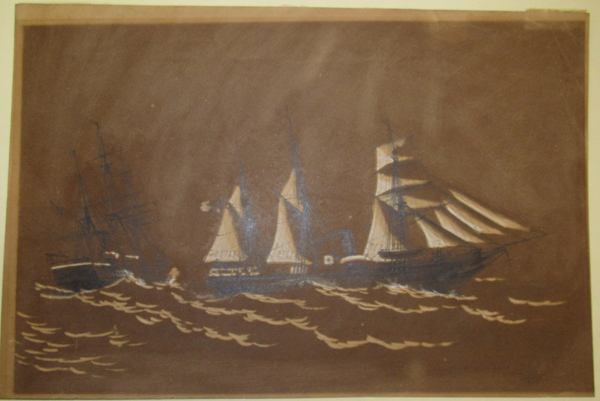
SHORT DESCRIPTION: Pencil and gouache drawing of the Coast Guard ships Thetis and Bear underway on choppy waves. The drawing is done on brown paper. NOTES: In 1881 the United States mounted an expedition to the arctic as part of the International Polar Year. The expedition was headed by Lt. Adolphus W. Greely of the US Army Signal Corps. Mishaps plagued the expedition including the sinking of the relief ship Proteus on July 23, 1883 which left the members of expedition without provisions. A Greely Relief Expedition was organized that included the ships Alert (donated by Great Britain), USS Thetis, a steam whaler purchased by the US Navy and the collier Loch Garry. The expedition was headed by Commander Winfield S. Schley, USN. Schley sailed northward, picking up dog sled teams and drivers in Greenland. The Thetis and Bear, the only ships capable of ramming a passage threw the ice, proceeded with the utmost speed. As the ships headed up the coast they periodically landed reconnaissance parties to seek out signs of the Greely expedition or to question the Eskimos. Near midnight on June 22nd, during a severe gale, the Greely survivors heard the whistles of the Thetis. Only seven of the twenty-six members of the expedition remained alive. The relief expedition and the survivors anchored at Portsmouth, Virginia where it was greated by the US Atlantic Fleet which "dressed every ship with every available flag and pennant." VESSEL NAME: THETIS VESSEL DIMENSIONS: 1200 tons displacement, 188.6 x 29.2 x 17.0 VESSEL TYPE: U.S. Coast Guard, auxiliary steam barkentine SHIPBUILDER: A. STEPHEN BUILDER LOCATION: Dundee, Scotland VESSEL BUILT: 1881. VESSEL INFORMATION - VESSEL NAMES: SS Bear (1874-1884) USS Bear (1884) USRC Bear (AG-29) (1885-1915) USCGC Bear (1915-1926) Bear (1926-1933) Bear of Oakland (1933-1938) USS Bear (1938-1948) Arctic Bear (1948-1963) VESSEL TYPE: Cutter, barkentine SERVICE DATE: 1874-1963 SHIP BUILDER: A. Stephen & Sons BUILDER LOCATION: Scotland, Dundee ASSOCIATED PLACE: Newfoundland, Alaska, Antarctica VESSEL HISTORY: [From: http://www.uscg.mil/history/webcutters/Bear1885.asp] The United States Revenue Cutter Bear was originally constructed as a sealer. She was built by Alexander Stephen & Son in their Dundee Shipyard (Yard No. 56) on the east coast of Scotland. She was completed in 1874 and delivered to W. Grieve of Greenock, Scotland. She spent the first ten years of her life getting her sea legs with a sealing fleet operating off Newfoundland. World-wide fame came to the Bear in the early 1880s shortly after the historic Greely Expedition to the Arctic came to a disastrous end. The Expedition, under the command of the then First Lieutenant Adolphus Washington Greely, U.S. Army, was one of two groups dispatched to the Arctic to set up a series of observation stations. Despite elaborately made plans, a series of misfortunes left Greely and his party stranded in the pitiless Arctic winter without adequate food and clothing. To assist the Greely party, the United States Navy organized a rescue fleet of three ships, consisting of the USS Bear, USS Thetis and the USS Alert. On 22 June 1884, less than two months after her departure, the Bear sighted the pitiful remnants of the expedition. For months they had been surviving on rock moss, leather sledding equipment, and whatever small game they could find. Many of the group had either died or gone mad from privation. Those who had survived resembled skeletons. The surgeon accompanying the expedition had committed suicide. For a while it looked as though the Bear's career was over. Not long after her return from the Greely rescue, she was declared unfit for further service by the Navy. Then in 1885, she was transferred to the Treasury Department for use in Alaskan waters and the Arctic Ocean. That was the beginning of a 41-year career on the Alaskan Patrol which has yet to be surpassed. Her first skipper was Captain A. A. Fengar but in 1885 the colorful "Hell Roaring"' Mike Healy, a dynamo of a man with an unpredictable temper, assumed command. Healy was a good skipper, and he commanded the Bear for more than nine years, longer than any other. He had another distinction as well: he was the first African-American to command a U.S. Government vessel. In time, Healy and his ship became legend in the lusty, brawling Territory of Alaska. The Bear's duties on the Alaskan Patrol were many. She carried mail which had accumulated at Seattle during the winter, as well as Government agents and supplies. On her trip south from Alaska, she transported Federal prisoners and other questionable characters whose presence in Alaska 'was undesirable. The deck of the Bear often served as a court where justice was dispensed swiftly but fairly. The Bear also conducted investigations, undertook crime prevention and law enforcement. She and other cutters like her were often the only law in that turbulent part of the world. The Bear also conducted soundings to improve charts of Alaskan waters, and her surgeon furnished medical attention and surgery to natives, prospectors, missionaries, and whalers. These duties are still part of today's Bering Sea Patrol. Not the least of Healy's s accomplishments was the importation of reindeer from Siberia to provide food for the natives who were never free of the threat of famine. As Healy reasoned it, the reindeer would also be an excellent source of clothing and transportation. The wisdom of this measure was dramatically proved a few years later during the famous overland trek to save marooned whalers near Point Barrow, Alaska. Of all the Bear's exploits, none has captured the public imagination more than her Overland Rescue of 1897. It was in the fall of that year that Captain Francis Tuttle, the Bear's new commander, learned that eight whaling vessels and their crews, totaling about 275 men, were trapped in the ice pack off remote Point Barrow, Alaska. The Bear had only recently returned from her patrol duties, but at the order of the Secretary of the Treasury, she prepared to go to the rescue. This was the first time that an Arctic voyage was attempted during the winter season. By 14 December 1897, it was clear that the Bear had come as far north as she could go. Approximately 85 miles off Cape Nome, the ice was so thick that she was forced to turn back. But before she returned, the Bear landed an over-land party on Nelson Island, near Cape Vancouver. It consisted of' First Lieutenant D. H. Jarvis, Second Lieutenant B. P. Bertholf, and Surgeon S. J. Call, all of the Revenue Cutter Service. Equipped with dog teams, sleds, and guides, Jarvis and his companions set out for Point Barrow. Before them lay a 1,600 mile journey through frozen, trackless wilderness. But the "Overland Expedition for the Relief of the Whalers in the Arctic Ocean" as it was ponderously called, became one of the great epics of the north. During the exhausting journey, Jarvis and Call collected a herd of nearly 450 reindeer. Driving the herd ahead of them in the face of icy winds the party reached Point Barrow about three and one-half months after being put ashore by the Bear. To the despairing whalers, the arrival of the relief party was nothing short of a miracle. Healy's foresight had paid off. The Bear, which had been in service since 1885 was still around in 1917 when the United States entered World War I. For the duration of the war she served under the U. S. Navy. This, however, did not change her routine patrol of Alaskan waters. In 1929 the Bear was decommissioned and turned over to the city of Oakland, California, for use as a maritime museum. It was at this time that she served as the set for the filming of Jack London's "Sea Wolf". The Bear was getting on in years now, but there was still some great moments ahead for the stout old ship. In the early 1930s, the famed Arctic explorer, Admiral Richard E. Byrd, USN, was looking for a vessel suitable for operating in ice in his Second Antarctic Expedition. Hearing that the Bear was available, he opened negotiations with officials of the City of Oakland, California, where the vessel had been serving as a marine museum. The bargain was concluded for the incredibly low price of $1,050 - one of the best buys in history. An entry in her log for 19 June 1932, reveals that she was en-route to Boston for overhaul and refitting with a volunteer crew aboard. Refitting completed, the Bear, on 25 September 1933 left Boston under the command of Lieutenant (j.g.) Robert A. J. English, USN. After a rugged trip, she reached the Bay of Whales and Little America in the latter part of January 1934. Once again in the United States Antarctic Expedition of 1939-41, Admiral Byrd called upon the Bear's services. This time, however, her boiler and engine were taken out and a modern diesel drive installed. Her auxiliary equipment was electrified. By 16 May 1941, she had completed her work in the Antarctic and was back at Boston. By this time, the shadow of World War II was already stretching over the United States. In 1941, shortly after her return from the Antarctic, the Bear was assigned to the Greenland Patrol. She took part in the capture of the Norwegian trawler Buskoe which had, been fitted out by the Germans to transmit weather reports and information on Allied ship movements. The Bear's days of active service were now drawing rapidly to a close. In June, 1944 she was stricken from the Navy list of active vessels and turned over to the Maritime Commission for sale. A Canadian steamship company purchased her in 1948 with the intention of converting her to her former role as a sealing vessel. But before this could be accomplished, the price of seal oil and skins dropped, and all work on her was stopped. For a while it seemed as though the Bear were doomed to end her days in obscurity on a Nova Scotia beach. She was spared this fate by Mr. Alfred M. Johnston of Villanova, Pennsylvania, who purchased her for eventual use as a commercial museum and restaurant near Philadelphia. The end came for the Bear as she was being towed to Philadelphia. Apparently, her old timbers were no longer strong enough to withstand the vicious battering of the North Atlantic. Now the Bear lies in her final resting place at the bottom of the Atlantic. After a legendary career, spanning several generations, she has at last found peace. But to all men who are interested in the lore of the sea, she will remain a shining symbol of courage. Her story will continue to be told as long as men sail the seas. MAJOR EVENT: Antarctic Expedition CAPTAINS OR OTHER RELATED PEOPLE: Admiral Richard E. Byrd SHIP OWNERS: U.S. Revenue Cutter Service VESSEL DIMENSIONS: 1700 tons displacement; 689 gross tons; 198'6" (loa); 190'4" (length at waterline) x 29'9" (beam) x 18'8" (draft)
Vols. 19-25 are published Amsterdam, E van Harrevelt et D.J. Changuion. By A.F. Prévost, continued by A.G. Meusnier de Querlon, A. Deleyre and J.P. Roussellot de Surgy, with subsequent additions by J.P.J. Du Bois and others. Vols. 1-10, p. 70 are translated from John Green's A new general collection of voyages and travels, London, T. Astley, 1745-47.
From http://www.history.navy.mil. Biography, George Dewey, the only officer of the US Navy ever to hold the rank of Admiral of the Navy, was born on 26 December 1837, in Montpelier, Vermont. On 23 September 1854, he was appointed Acting Midshipman from the first Congressional District of Vermont, and upon graduation from the US Naval Academy in June 1858, was warranted Midshipman, to date from 11 June of that year. He became a Passed Midshipman on 19 January 1861, and on 28 February of the same year he was warranted Master. His subsequent advancement was as follows: Lieutenant, 19 April 1861; Lieutenant Commander, 3 March 1865; Commander, 13 April 1872; Captain, 27 September 1884; Commodore, 28 February 1896; Rear Admiral, 11 May 1898; Admiral, 2 March 1899; and Admiral of the Navy on 24 March 1903 to date from 2 March 1899. During the period 26 April 1861, until 30 August 1867, he had consecutive service on USS Mississippi, USS Brooklyn, USS Agawam, USS Colorado, USS Kearsarge, USS Canadiagua, and again USS Colorado. When detached from the latter he was directed to await orders of 1 October 1867, which returned him to the Naval Academy for a tour of duty which ended in September 1870. On 10 October 1870, he assumed command of USS Narragansett, and in February 1871 was transferred to command of USS Supply, hospital ship. On 27 July 1871, he was ordered to the Navy Yard, Boston, Massachusetts, and after five months' duty there and brief instruction at the Naval Torpedo Station, Newport, Rhode Island, he again commanded Narragansett from 1 March 1873, to August 1875. Ordered on 25 August 1875, to report as Lighthouse Inspector, Second Naval District, at Headquarters in New York, New York, he served in that capacity until 1 August 1877, and as a member of the Lighthouse Board for eight months thereafter. On 1 May 1878, he became Secretary of the Lighthouse Board. On 18 October 1882, he was ordered to command USS Juniata, and remained at sea from 25 October that year until July 1884, when he was ordered detached and to the Navy Department, Washington DC. Again at sea, he commanded USS Dolphin from October 1884 until March 1885, when he transferred to command of USS Pensacola. On 1 August 1889, he was commissioned Chief of the Bureau of Equipment, Navy Department, Washington DC. His term ended by resignation on 30 June 1893, when he again became a member of the Lighthouse Board. On 5 November 1895, he reported for duty as President of the Board of Inspection and Survey, Navy Department. On 30 November 1897, he was ordered to Asiatic Station and, proceeding by steamer, he assumed command on 3 January 1898, his flag in the protected cruiser, USS Olympia, Captain Charles V. Gridley, commanding. The Spanish-American War action at Manila, Philippine Islands, 1 May 1898, not only gave birth to the historical expression "You may fire when you are ready Gridley," but also liquidated the Spanish Fleet and installations in the Manila Harbor without loss of men to the US Fleet. On 10 May 1898, Admiral (then Commodore) Dewey was given a vote of thanks by the Congress of the United States, and three days later was commissioned Rear Admiral, to date from 11 May 1898. That promotion was an advancement of one grade for "highly distinguished conduct in conflict with the enemy as displayed by him in the destruction of the Spanish Fleet and batteries in the harbor of Manila, Philippine Islands, May 1, 1898." He was relieved of command of Asiatic Station on 4 October 1899, and ordered to the Navy Department, Washington, where on 29 March 1900, he was designated President of the General Board. An Act of Congress, 2 March 1899, created the rank of Admiral of the Navy. It provided that when such office became vacant either by death or otherwise, the office would cease to exist. On 24 March 1903, Admiral Dewey, who held the rank of Admiral since 8 March 1899, was commissioned Admiral of the Navy, with date of rank 2 March 1899, and became the only officer of the United States Navy who was ever so commissioned. He held the rank of Admiral of the Navy until his death in Washington, DC, on 16 January 1917. The body of Admiral Dewey was interred in Arlington National Cemetery, Arlington, Virginia, on 20 January 1917. At the request of his widow, his remains were reinterred in the crypt of Bethlehem Chapel at the Protestant Episcopal Cathedral, Mount Saint Alban, Washington, DC, on 28 March 1925. Besides his widow, Mrs. Susan Goodwin Dewey, Admiral Dewey was survived by his only son, George Goodwin Dewey. Admiral Dewey earned the Civil War Medal; the Spanish Campaign Medal; the Philippine Campaign Medal; and the Dewey Medal (commemorating the Battle of Manila Bay). A destroyer, USS Dewey (DD-349), was named to honor Admiral of the Navy George Dewey. Built by the Bath Iron Works Corporation of Bath, Maine, she was launched on 28 July 1934, under the sponsorship of Miss Ann M. Dewey of Quechee, Vermont, great-grandniece of Admiral Dewey. Dewey was placed in commission at the Boston Navy Yard on 4 October 1934, and earned thirteen battle stars for operations in the Pacific War Area during World War II. [Adapted from: Navy Office of Information. Internal Relations Division. "Admiral of the Navy George Dewey, United States Navy, Deceased." 17 May 1963. George Dewey ZB file, Navy Department Library] "Dewey at the Battle of Manila" 1 May 1898. Depicting Dewey on the Bridge of His Flagship Olympia (C-6), in the Spanish-American War. Service Record of George Dewey Born in Montpelier, Vermont, 26 December 1837. Died in Washington, DC, 16 January 1917. Appointed Midshipman, 23 September 1854. Commissioned Lieutenant, 19 April 1861. Commissioned Lieutenant Commander, 3 March 1865. Commissioned Commander, 13 April 1872. Commissioned Commodore, 9 February 1896. Commissioned Rear Admiral, 1 May 1898. Commissioned Admiral of the Navy, 2 March 1899. Service: Took prominent part in the operations of the West Gulf Blockading Squadron, under Admiral Farragut. First Lieutenant of USS Mississippi in attacks on Forts Jackson and St. Philip, capture of New Orleans, and Battle of Port Hudson. Commended for gallantry, judgment and skill in action between Mississippi and enemy's forts at Port Hudson, and the rescue of the crew from the burning ship when set on fire by the enemy's shot. Participated in attacks on Fort Fisher, 24-25 December 1864 and 13-15 January 1865. Commanded the Asiatic Squadron 1897 - 1898. 1 May 1898 destroyed or captured the Spanish fleet in Manila Bay, captured land batteries at Cavite and took possession of Manila, for which he received the thanks of Congress and was promoted to Rear Admiral. Appointed Admiral of the Navy by President McKinley and confirmed by Congress, 2 March 1889. [Adapted from: "Admiral George Dewey." Memo for the Bureau of Navigation, dated 26 July 1917. George Dewey ZB file, Navy Department Library] George Dewey, Admiral of the Fleet. By Ammen Farenholt, Rear Admiral, Medical Corps, US Navy (Retired) The 26th of December marks the birthday of one of our most colorful naval commanders and one who, as an able and fearless officer, an excellent seaman, a smart diplomat and a polished gentleman, had no superior in our service. Admiral Dewey possessed a very full measure of resourcefulness, justice and common sense, qualities which we like to regard as "Yankee" characteristics. He was far from being a martinet or an ogre but he could never suffer fools gladly and his prompt decisions and quick temper were sometimes, wrongly, resented as irascibility and eccentricity. The following three anecdotes may interest the men of this newer and therefore somewhat different navy. The Admiral and the Army gunboats In 1899 matters of jurisdiction and policy in the Philippines in general and in the local vicinity of Manila in particular, had not been fully settled and occasionally someone's toes were stepped on. The senior naval officer was of course Admiral Dewey who had destroyed the Spanish fleet and had only refrained from requiring the immediate surrender of the city of Manila because of his inability to properly police it. General Otis was for a long time the senior Army officer and as such supreme ashore. The affairs of the newly acquired territory were conducted by a joint board in which the Admiral and the General were the most influential members. The sessions were held on shore and usually passed off in more or less harmony and accord but on at least one occasion Dewey, who was not particularly patient in long winded discussion, just couldn't stand it any longer and stalked out of the meeting, down to his barge, Cristina, and back to Olympia. In order to properly police the Passig river and the adjacent back country it was necessary to have armed force on that active waterway. This duty fell to the Army and four vessels were so employed; the Oeste, a large tug given to the Army by the Navy; the Napindan, the Covadonga and the larger Laguna de Bay, the flagship. The two latter were chartered or commandeered vessels. Laguna de Bay had sloping casemated upper works and looked like a small edition of the confederate Merrimack [CSS Virginia]. All four were well protected with boiler plate and railroad iron. This fleet was manned chiefly by personnel of the regular 3rd US Artillery. Occasionally this non-descript collection, which was efficient and sufficient for the required purposes but far from "ship shape and Bristol fashion", would come out of the Passig river for a turn about the bay on some business or other. Now the waters of the bay were the Admiral's particular bailiwick and each time they were reported beyond the light-house Dewey would become nearly apoplectic with wrath and would order them back. Finally he sent a direct order, it might have been a request but if Dewey wrote it when annoyed it certainly would have had the character of an order, to General Otis to the effect that if he ever caught one of them outside of the river again he would sink her. They never reappeared in those forbidden waters for the General probably didn't know just how far the forceful Admiral really would go and would rather not provoke a show down. The Society of the Dog Admiral Dewey had on board Olympia as his pet a badly spoiled dog. He was very fond of it and in his eyes it could do no wrong; however he was alone in that opinion and both officers and the crew, particularly the afterguard sweepers, detested the animal. The dog was smart enough to know that his sole protector was the Admiral and ran back to him if he had been maltreated, whenever anyone touched or made a pass in his general direction. Several men were punished, some justly and perhaps some not quite so justly, and a quartermaster was dis rated. Partly in a spirit of waggishness and born of the monotony of the blockade in Manila bay before the fall of the city the men formed a very secret organization called the "Society of the Dog." To be an ordinary member a man had to have kicked the brute, but to become a member first class he had to have kicked him while the Admiral was on deck and could possibly have seen him do it, or had performed some other allied act of equal daring. There were very few of these. The organization lasted as long as the dog did for one morning he turned up missing. That day a first class member was hurriedly promoted to the office of "Chief Superior Dog" and the society prudently disbanded. "Chief Superior Dog" was an afterguard sweeper. The Capture of the Spanish Gunboat Leyte At the time of the outbreak of the Spanish war, Revenue Cutter, later Coast Guard, McCulloch, was at sea on an extended shakedown cruise from Hampton Roads to her assigned station at San Francisco and on her arrival at Singapore orders were received to proceed with all possible speed to Hong Kong and report to Commodore Dewey for further duty. The ship arrived on 17 April and sailed with the fleet for Mirs Bay and Manila a week later. While a small vessel and not built for naval service she was a very welcome and valuable addition to the fleet and she performed excellent patrol and dispatch service throughout the period of hostilities and until November 1898 when she resumed her voyage to San Francisco. Captain Ridgley USCG [US Coast Guard] who was attached to the ship tells the following story. On 29 June a signal was received from Olympia which read "Spanish gunboat sighted bearing north-west apparently attempting to reach Manila, intercept and capture." That time McCulloch broke her record, getting underweigh in one minute and dragging her anchor and a course was shaped to get between the gunboat and the foreign shipping of Manila. The stranger changed her course to meet the cutter head on flying a flag at the fore, a pennant at the main and a flag at the gaff, all indistinguishable because of the light airs, but on closing in on her it was found that she was flying a white flag at the fore. After heaving to a boarding officer was sent aboard and found her to be the Spanish gunboat Leyte which had escaped during the early morning of 1 May, and had remained in hiding in one of the numerous rivers emptying into the bay, but could neither escape to sea or avoid the attacks of the Filipino insurgents and so her commanding officer decided to surrender. The Spanish flag was hauled down, the United States ensign [the American flag] hoisted and with a prize crew aboard she proceeded to Olympia and anchored off her starboard quarter. McCulloch accompanied her and sent a whale boat to the Leyte to take her commanding officer and the prize master to the flagship. In the meantime a heavy rain squall had kicked up quite a choppy sea; also that morning the ship had coaled from a casco alongside and some "bino" had, as usual, come on board so the boat's crew didn't pull in the style and form usual in the Navy in those days. Once alongside the two officers mounted the gangway and were escorted to the Admiral, sitting as usual in his wicker chair on the quarterdeck. "I have to report the capture of the Spanish gunboat Leyte, Sir and to deliver the commanding officer on board" rather proudly announced the prize master. If he expected, as was perhaps excusable, a hero's welcome he certainly "missed out" for the Admiral only looked up sharply and said; "Very well sir and I want to tell you that your boat's crew pull like a lot of damn farmers!" From that wicker chair on the quarterdeck there was very little that went on in Manila bay that escaped Admiral Dewey's sharp eyes, and quite likely, a sharp signal to follow. [Adapted from: Farenholt, Ammen. "George Dewey, Admiral of the Fleet." n.d., George Dewey ZB file, Navy Department Library.] [Note: The Naval Historical Center does not support or condone the mistreatment of animals. The portion of the above essay dealing with The Society of the Dog was retained because the presence of animals on US Navy Ships is an element of the social history of the Navy and not well documented.] Act creating the office of Admiral of the Navy CHAP 378 - An act creating the office of Admiral of the Navy. Be it enacted by the Senate and the House of Representatives of the United States of America in Congress assembled, That the President is hereby authorized to appoint, by selection and promotion, an Admiral of the Navy, who shall not be placed upon the retired list except upon his own application; and whenever such office shall be vacated by death or otherwise the office shall cease to exist. Approved, March 2, 1899. [Source: Statutes of the United States of America Passed at the Third Session of the Fifty-Fifth Congress, 1898-1899, and Recent Conventions, Treaties, Executive Proclamations, and Concurrent Resolutions of the Two Houses of Congress. Washington, DC: Government Printing Office, 1899: 995.] Navy general orders concerning death of Admiral of the Navy George Dewey General Order No. 258 Navy Department, Washington, 17 January 1917. It is with feeling of genuine grief that the Secretary of the Navy announces the death at 5.56 p.m. yesterday at his residence in Washington of The Admiral of the Navy. The career of George Dewey "ran in full current to the end." Vermont was his mother State and there was always in his character something of the granite of his native hills. Dewey was under fire with Farragut in the Mississippi River, and bore himself gallantly throughout the War between the States. The battle in Manila Bay on 1 May 1898, made him the foremost naval officer since Farragut and victor of the first American sea fight with a foreign foe since the War of 1812. "Gentlemen, a higher power than we has won this battle to-day," the commodore said to his captains at the conclusion of the battle when it had been learned that the victory, one of the most decisive in our history, had been one without the loss of a single American seaman. In peace, in war; in sickness, in health; in victory and in conflict, and in every relation of life Admiral Dewey invariably exhibited the virtues of the patriot and the Christian. His whole life, 62 years of which, were spent in the Navy, was full honorable achievement, and his service in peace has been hardly less distinguished than his laurels in war. As president of the General Board of the Navy since its inception he has played a leading part in making the Nation ready for war on the seas. The same statesmanlike qualities which he exhibited in handling the international situation at Manila after the battle of 1 May 1898, he has shown as the head of this board of naval experts. In recognition of his victory in Manila Bay the then commodore was advanced one grade to that of rear admiral, and in addition received the thanks of Congress. Later by special act of Congress he was promoted to be The Admiral of the Navy, a rank never held by an American naval officer previously, although two, Porter and Farragut, were rewarded with the rank of full Admiral. He was placed by Congress on the active list until such time as he might see fit to apply for retirement. But his active spirit could not rest. He never folded his hands. He chose to die on the bridge, even until the Pilot came aboard his life craft who should take him across the bar. He died one of the foremost figures of modern times. The flag will be displayed at half-mast at all navy yards and stations, and on board all ships in commission until after the funeral shall have taken place, and 19 minute guns will fire at noon on the day of the funeral from each navy yard and from the senior ship present afloat. All officers of the Navy and Marine Corps will wear the badge of mourning with the uniform for 30 days. The Navy Department, by executive order will be closed on Saturday, 20 January 1917. Josephus Daniels, Secretary of the Navy - General Order No. 259. Navy Department, Washington, 18 January 1917. The following executive order and message of the President to the Senate and House of Representatives are quoted for the information of the naval service. Josephus Daniels, Secretary of the Navy Executive Order As a token of respect to the memory of Admiral George Dewey, who died at his residence in the city on yesterday, January 16, at 5.56 o'clock, it is hereby ordered that the national flag be displayed at half-mast upon all public buildings and at all forts and military posts and naval stations, and on all vessels of the United States in commission until after the funeral shall have taken place, and that on the day of the funeral the executive offices in the city of Washington be closed. Woodrow Wilson, The White House, 17 January 1917. - To the Senate and House of Representatives: It is with the deepest regret the I announce to the Congress the death of Admiral George Dewey at 5.56 o'clock on the afternoon of yesterday the 16th of January, at his residence in this city. Admiral Dewey entered the naval service of the country as an acting midshipman from the first congressional district of Vermont on 23 September 1854: was graduated from the Naval Academy as midshipman 11 June 1858; served throughout the war of 1861-1865; and 30 years later had risen to the rank of commodore. It was as commodore that he rendered the service in the action of Manila Bay which has given him a place forever in the naval annals of the country. At the time of his death he held the exceptional rank of The Admiral of the Navy by special act of Congress. During the later years of his life he was the honored president of the General Board of the Navy, to whose duties he gave the most assiduous attention and in which office he rendered a service to the Navy quite invaluable in its sincerity and quality of practical sagacity. It is pleasant to recall what qualities gave him his well-deserved fame: His practical directness, his courage without self-consciousness, his efficient capacity in matters of administration, the readiness to fight without asking questions or hesitating about any detail. It was by such qualities that he continued and added luster to the best traditions of the Navy. He had the stuff in him which all true men admire and upon which all statesmen must depend in hours of peril. The people and the Government of the United States will always rejoice to perpetuate his name in all honor and affection. Woodrow Wilson, The White House, 17 January 1917. [Source: Subject Index to General Orders, Navy Department, Series of 1913. (Complete to June 30 1916). Washington, DC: Government Printing Office. 1916.] Admiral of the Navy George Dewey: A Select Bibliography Books Periodicals Documents Books Adams, W. H. Davenport. Dewey and Other Great Naval Commanders, a Series of Biographies. New York: G. Routledge, 1899. Acting Rear-Admiral George Dewey: Message from the President of the United States, Recommending That the Thanks of Congress Be Given Acting Rear-Admiral George Dewey, of the United States Navy, for Highly Distinguished Conduct in Conflict with the Enemy, and to the Officers and Men Under His Command for Their Gallantry in the Destruction of the Enemy's Fleet and the Capture of the Enemy's Fortifications in the Bay of Manila, May 1, 1898. Washington, DC: Government Printing Office, 1898. Albion, Robert Greenhalgh. Makers of Naval Policy 1798-1947. Annapolis MD: Naval Institute Press, 1980. [see index for "Dewey, George"] American National Biography. Vol 6. New York: Oxford University Press, 1999. [see "Dewey, George," pp. 511-514]. Barrett, John. Admiral George Dewey: A Sketch of the Man. New York: Harper, 1899. Clemens, William Montgomery. Life of Admiral George Dewey. New York: Street & Smith. 1899. Cogar, William B. Dictionary of Admirals of the U.S. Navy. vol. 1. Annapolis, MD: 1989. [see "Dewey, George," pp. 46-48]. Dewey, Adelbert Milton. The Life and Letters of Admiral Dewey from Montpelier to Manila, Containing Reproductions in Fac-Simile of Hitherto Unpublished Letters of George Dewey During the Admiral's Naval Career and Extracts from His Log-book, by Adelbert M. Dewey, Assisted by Members of the Immediate Family. Embellished with Over Two Hundred and Fifty Illustrations. Akron, OH., Werner Co., 1899.

 MS0091-03-01-01-061
 MS0091-03-01-01-062
 PB18428
 Full-size image
 Full-size image
 Full-size image
 Full-size image
 Full-size image
 Full-size image
 Full-size image
 Full-size image
 Full-size image
 Full-size image
 lp270
 lp3627
 Full-size image
 MS0094-6004 Admiral Schley
 P0003-01 - L-14171
 Full-size image
 le1300
 Full-size image
 Full-size image
 Full-size image
 Full-size image
 lp1593
 Full-size image
 le553
 lp2151
 Full-size image
 Full-size image
 P0003-01 - L-6674
 P0003-01 - L-14411
 Full-size image
 q10
 PP113-c64